Appearance
Semantic Triggers
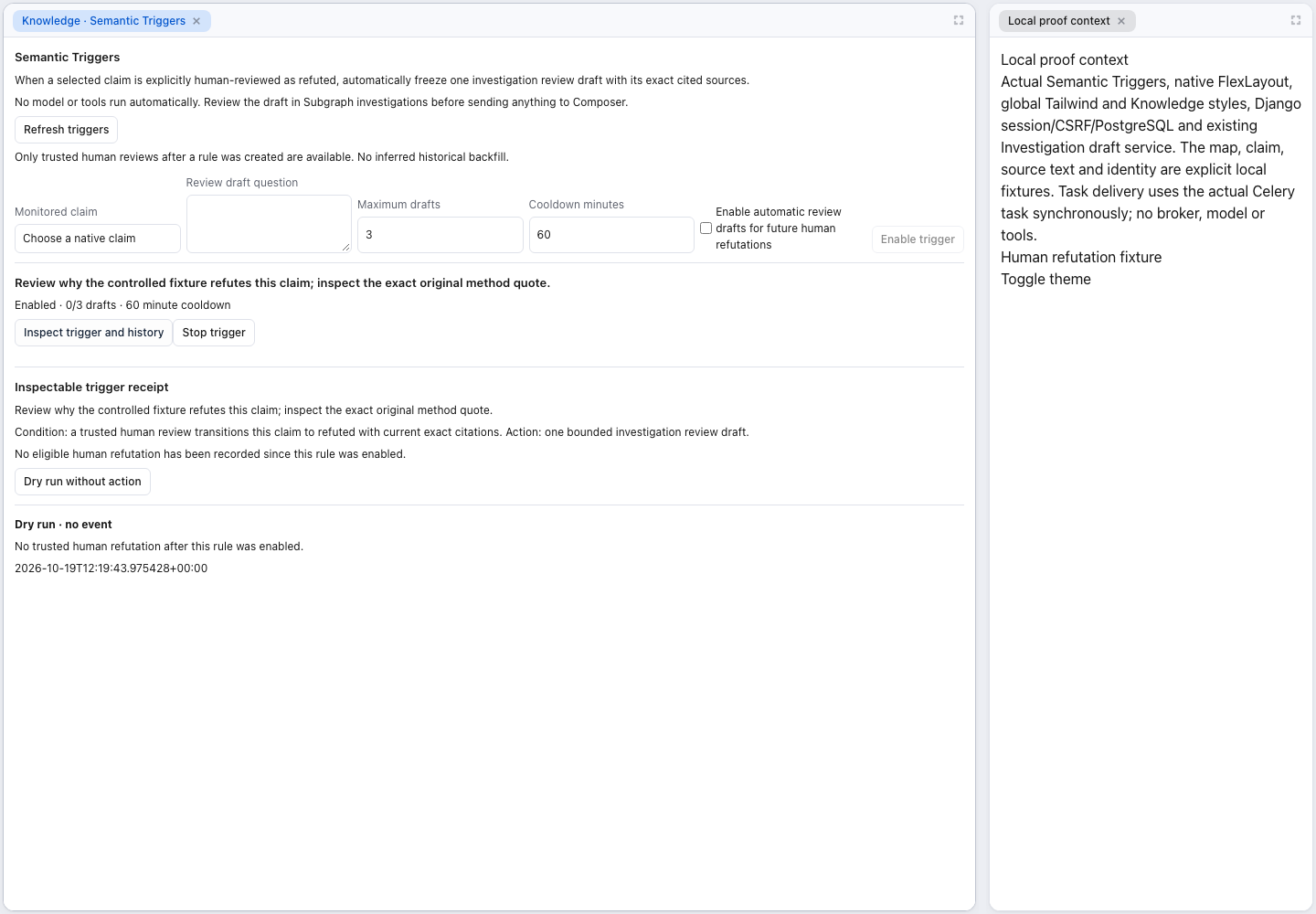
Open Knowledge → Discover → Semantic Triggers in your map. Choose a native Composer claim, state the review draft question, set a maximum draft count and cooldown, then explicitly enable automatic drafts. The rule is private to your account and this Space/map.
When a future human review changes the claim to refuted, Mantis rechecks current write access, map containment, the exact original citation quotes/hashes and the reviewed claim. It freezes one bounded native investigation review draft. No model or tools run automatically and no claim truth is changed by the trigger. Open the draft in the existing Subgraph investigations tool, inspect its admitted originals, and deliberately prepare Composer only if you want further research.
Inspect trigger and history shows the explicit condition, source quotes/hashes, trusted review commit, dry-run outcomes and delivery receipts. Dry run without action records what would match or be suppressed, without creating a draft, spending its budget or starting cooldown. A review event can produce only one draft for each rule. Cooldown, stopped rules, exhausted budgets or changed evidence suppress another delivery. Retry queued delivery advances the original durable receipt; it never invents a new action.
If an acknowledgement is lost, Retry exact intent preserves the original request across closing and reopening the panel. Finish that acknowledgement before editing another rule. Refresh triggers reloads the current private state. Stop an enabled rule when it should no longer admit drafts.
This first release supports one explicit condition: a trusted human review transitions a selected native claim to refuted with current exact citations. Generic property edits, a lookalike commit reason, source hash movement or approximate similarity cannot produce that event. Only trusted reviews admitted after a rule was enabled are available; no older review history is inferred. A legacy review without the stricter exact-quote basis remains a valid human review but does not dispatch this trigger.
Limits are 20 rules per account/map, 100 per map, 20 exact citations per event, 20 drafts and 128 receipts per rule, with a cooldown from one minute to one day. A draft admits a nontruncated one-hop neighborhood within the existing 4MB evidence limit. Drafts remain hypotheses for explicit review.
Verified native walkthrough
The recording uses actual Semantic Triggers, shared controls, compiled global Tailwind and Knowledge styles, and native FlexLayout with Django session/CSRF/PostgreSQL. The map, claim, original source content and identity are clearly synthetic local fixtures. The actual Celery task executes synchronously after the trusted review commits; this does not claim a running broker, provider login, full production workspace or any model/tool execution. The fixture initializes the normal font token fallback used by the platform.
It demonstrates explicit enablement, a genuinely applied create whose first acknowledgement is lost, close/reopen and the identical UUID/body retry, a no-action dry run, a trusted human refutation automatically creating one native draft, frozen original inspection, deduplicated dry-run history, light/dark and a settled 349px panel without overflow or browser errors. Source hashes are identical before and after. The frozen product heads are API b99f1fe0e and UI 3a7d575e9; later test/docs commits do not relabel those recordings.
The companion API and its dedicated semantic_triggers.0001_initial migration must land before this frontend. Upgrade all review-serving API pods and workers before enabling rules, so every trusted review path can admit the event.